 Bar & Beat
Pulse
The beat keeps going when the notes change
A row of notes can make rhythm look like a collection of objects to be counted one by one. The beat is a different idea: a regular reference against which those note lengths and attacks are understood. Several short notes can share one beat, while one long note can last across several beats. If every note receives the same spoken count, the written relationships disappear. Begin with a steady, comfortable pulse and let the notes fit around it. The aim is not to make every sound equally long, but to keep a consistent reference while their lengths vary.
One count can hold more than one event
For a simple desk exercise in common time, tap four evenly spaced beats and speak “one, two, three, four.” Repeat without speeding up at the end of the group. Now place two equal spoken syllables within each beat: “one and, two and, three and, four and.” The numbers remain at the original pulse points. The extra syllables divide the space between them. This exercise uses an ordinary simple division; it is not a universal explanation of every meter or rhythmic style. Its value is making two layers audible at once without needing a long musical passage.
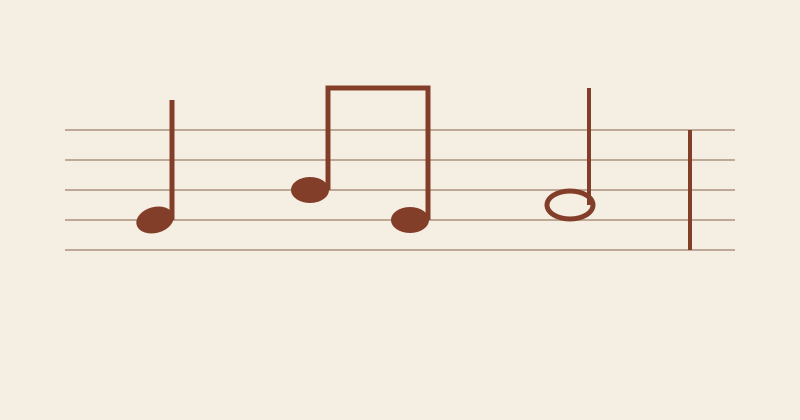
A quarter note can occupy one beat in a context where the quarter note is the beat unit. Two eighth notes then divide that duration equally in straight notation. Change the meter or performance convention and the way the beat is felt can change, so keep the example's context attached to it. Do not turn “quarter note equals one beat” into an unconditional rule. The note symbol represents a relative duration. The time signature and musical context help explain how that duration relates to the pulse being used. This distinction prevents several later confusions from growing out of an easy first shortcut.
Keep the pulse through a long sound
Try holding one spoken vowel for four taps. The sound begins at the first tap and continues while the remaining pulse points occur underneath it. You do not need to restart the vowel at each tap to prove that the beats exist. Then alternate one four-beat sound with four separate one-beat sounds. Listen to whether the underlying pace stays similar across the change. If the long sound encourages you to drift, shorten the exercise and use quiet spoken counts. A brief clear comparison is more useful than a long repetition in which the two layers gradually merge.
Silence offers the same lesson. A rest does not remove the pulse; it leaves a measured space within it. Tap four beats and speak only on the first and third. The second and fourth still need to pass at the same pace. This can feel less obvious than a full row of notes because the silent part provides no attack to follow. Keep the exercise plain. There is no need to add accents, syncopation, or a faster tempo until the basic relationship is clear. Complexity should come from the music you want to understand rather than from a need to make the drill look advanced.
A useful listening question
When listening to a short familiar passage, ask whether you are following each note or an underlying regular reference. You may hear more than one plausible level of pulse, particularly in music with broad phrases or quick subdivisions. This does not mean every listener must tap at the same rate for the listening to be worthwhile. For a notation exercise, choose the pulse level specified by the example and stay with it long enough to compare the note durations. Label that choice instead of treating your first tap as an objective answer to every rhythmic question in the passage.
The practical result is a clearer separation of jobs. The beat offers a steady framework; notes and rests describe events within it. When a difficult rhythm becomes confusing, return to those two layers before increasing speed. Count a short span, identify where the attacks fall, and preserve the silent or sustained spaces between them. A steady reference does not make the music mechanical. It gives the changing events a shared place to happen, which makes both the notation and the sound easier to discuss.
Keep reading